You get it allnever mind.
but you speakIt was good.
in simple phrases.it’s fine.

A word is usually learned up to “I recognise it in a list”. Here it goes to “I said it in a conversation”: you recall it yourself, say it, and after that it turns up without a pause.

Get it for iPhone

Free to start. The first five minutes are already practice.
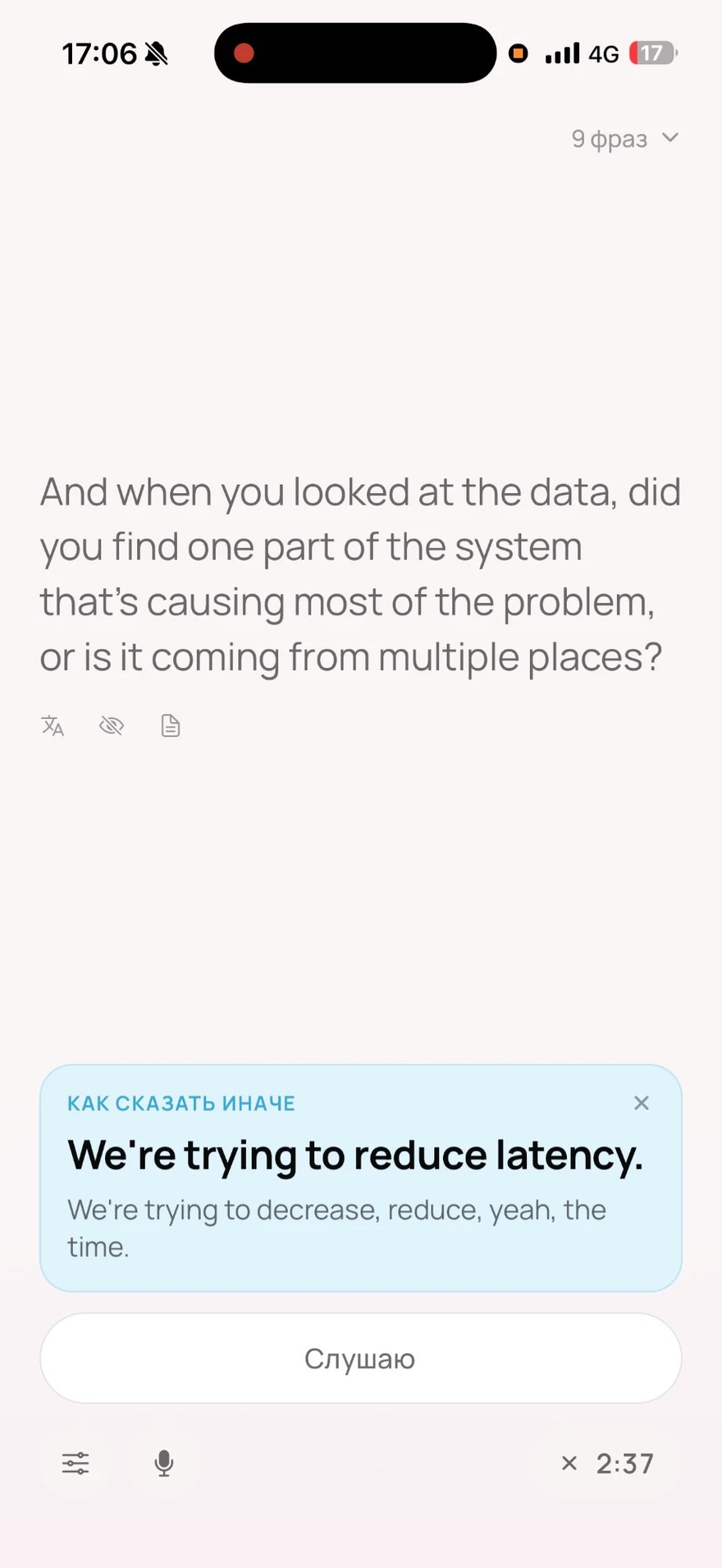
prompts you while you talk
A Wispy conversation screen: a prompt showing how to say the same thing better
Known, but never said
Let's park that for now. ·That's a fair point. ·Can we circle back? ·I'm not sold on it. ·Let me rephrase that. ·No pressure either way. ·That's on me. ·Give or take a day. ·Worth a shot. ·It slipped my mind. ·I'd rather hold off. ·Fair enough. ·That tracks. ·Let's tackle the big one first. ·Let's park that for now. ·That's a fair point. ·Can we circle back? ·I'm not sold on it. ·Let me rephrase that. ·No pressure either way. ·That's on me. ·Give or take a day. ·Worth a shot. ·It slipped my mind. ·I'd rather hold off. ·Fair enough. ·That tracks. ·Let's tackle the big one first. ·
Why it never worked

Recognising and speaking are two different skills.

You trained the first one: reading, listening, recognising — and it grew. The second grows only when you recall a word yourself and say it, and that is exactly what word lists and flashcards never asked of you.

recognisespeakgap
years with the languageafter Laufer, 1998
What happens here
There are new words here, same as anywhere. The difference is that you start saying them — the new ones and the ones you have known for years.
Swain & Lapkin, 1995 · Applied Linguistics

Trying to say something makes you notice what's missing — reading doesn't do that.

Bjork & Bjork, 2011 · UCLA

What is hard to retrieve yourself is remembered better than what you were prompted with.

How it works

How a word reaches your speech.

Four steps that repeat day after day. About ten minutes, and the circle closes.

01
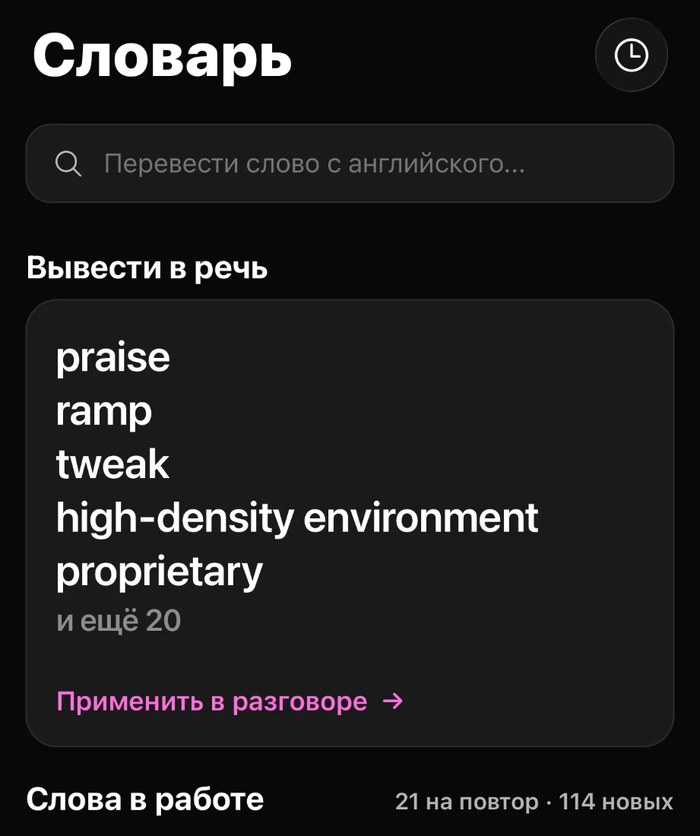
You keep the word

Something unfamiliar from an article, a show or a work chat. You look it up, and it lands in your dictionary.
02
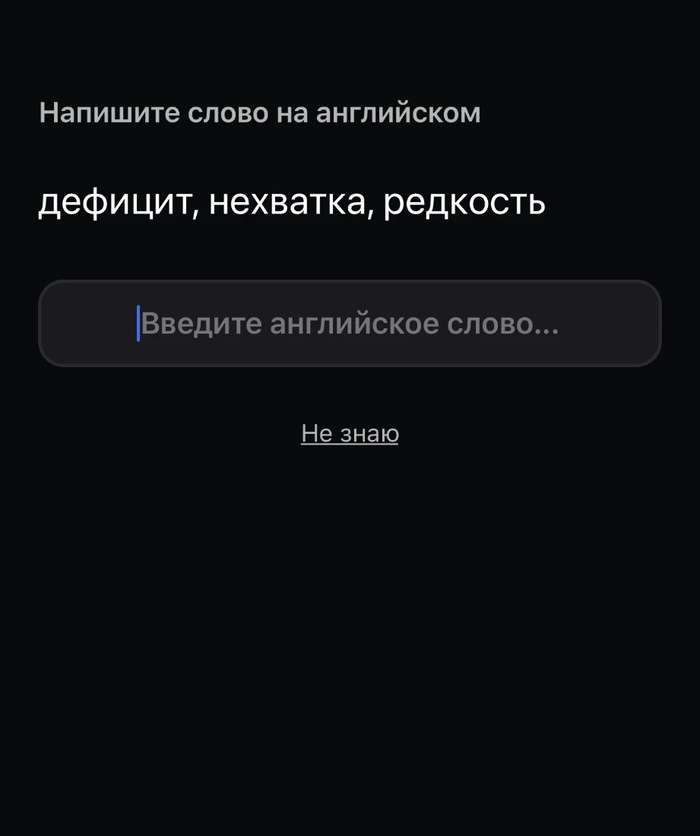
You recall it yourself

The word has to be written or spoken by you. Writing gives you time to think — saying it out loud comes later, and easier.
03
You say it out loud

Your voice, a real topic, the clock running. The word waits in a prompt — you just fit it into your own sentence.
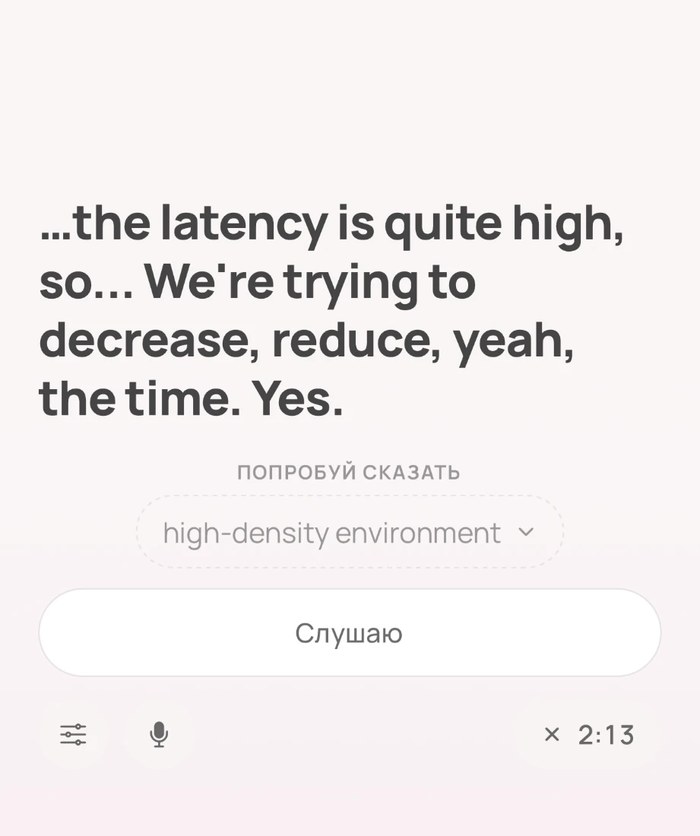
04
You hear how it sounds better

The phrase came out clumsy — and here is the version people actually use for the same thought.
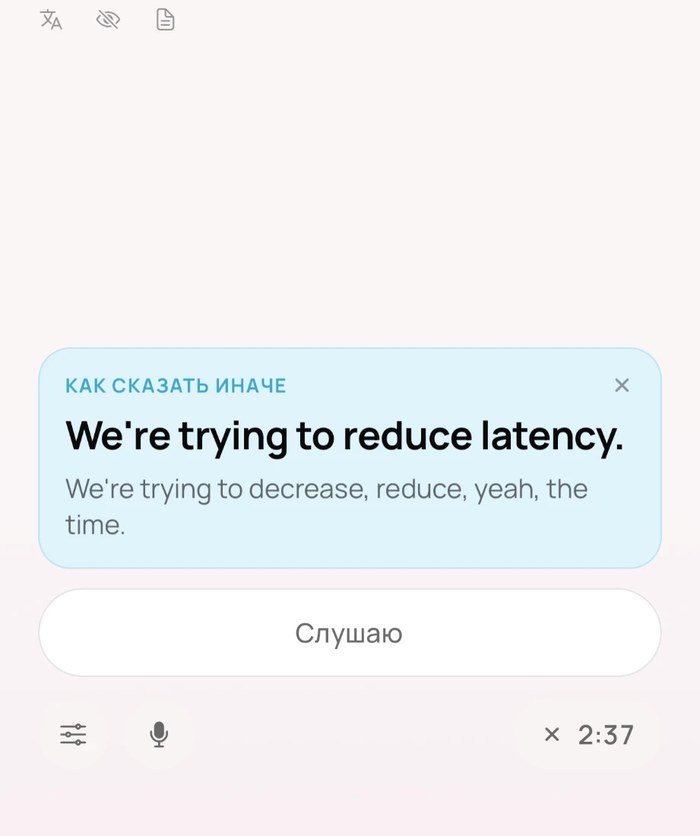
A day or two later the word comes back — until it starts coming out on its own
What it asks of you

Nobody will say it for you.

Picking from a list is easy — which is why it is not work. The sentence has to be built by you, out of the words you already have, so that you are understood.

Out loud or in writing, whichever suits. Your sentence stays yours even when there is nowhere to say it yet.

This part is yours
your sentence…
Feedback

The idiom lands. Slightly more natural: “This exam is a sink-or-swim situation.”

Why not them

There are easier ways.

Any AI
Anything can talk to you these days, and it will be delighted with whatever you say. It just will not notice that you keep chewing the same words, and will not offer a replacement. A month on, you still will not know whether you got better.
You’re absolutely right!
A tutor
An hour on a schedule — and for most of it they are the one talking. You make your mistakes in front of a person.
can we move it to Thursday?
A conversation club
At the table you need to be understood, and familiar words get you there faster. No time to try new phrasing.
Yeah, totally.
Doing nothing
Your English will not get worse: the passive side grows on its own — from reading, from shows, from chats with a dictionary open. The active side does not. It moves only when you build the sentence yourself — out loud or in your own written words.
starting Monday
Situations

You train conversations that actually happen, not topics.

56 topics across three tracks, 222 exercises. Here are some real ones.

Founders and work
Delivering Bad News
Announce a layoff or a shutdown
The Mom Test Interview
Ask so that you hear the truth
Answering Investor Questions
Field an awkward question about rivals
Social life
Lunch with Colleagues
Casual lunch talk that is not about work
American Friendliness vs Actual Friendship
Tell warmth apart from friendship
The «What Are We?» Conversation
The talk about what you two actually are
Relocation and daily life
Visa Application Vocabulary
Make sense of the words on a visa form
Questions to Ask at Viewings
Ask at the viewing what you'd regret not asking
Formal Complaint Letters
Write the complaint your landlord can't ignore
Specials

Learning shouldn't be boring.

Separate modules built on what you already watch, listen to and play. The English is real — the excuse is just better than a textbook.

Series
House of the Dragon: The Language of Power

The English of claims, oaths and scheming. Turns out Westeros sounds a lot like Monday meetings.
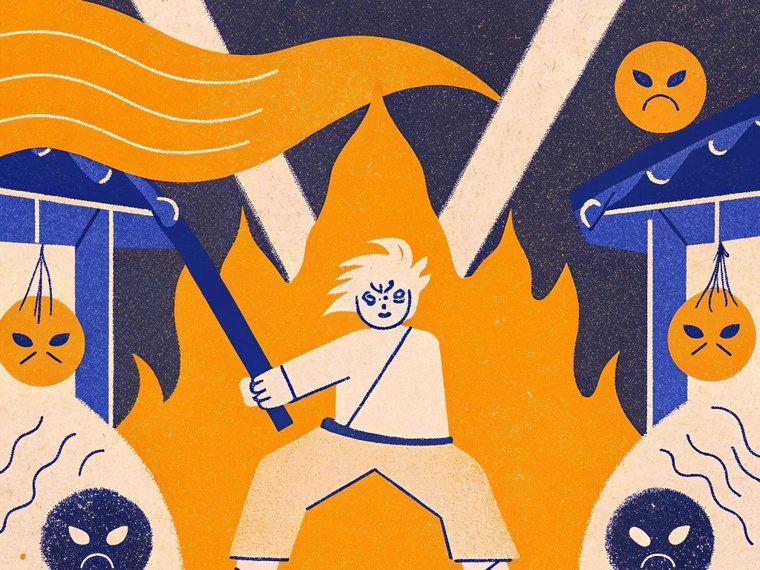
Anime
Jujutsu Kaisen: Confidence & Arrogance

The English of confidence and arrogance — through Gojo and Sukuna.

Gaming
GTA VI: Vice City Slang

American slang, hype culture and satire from the most anticipated game of the year.
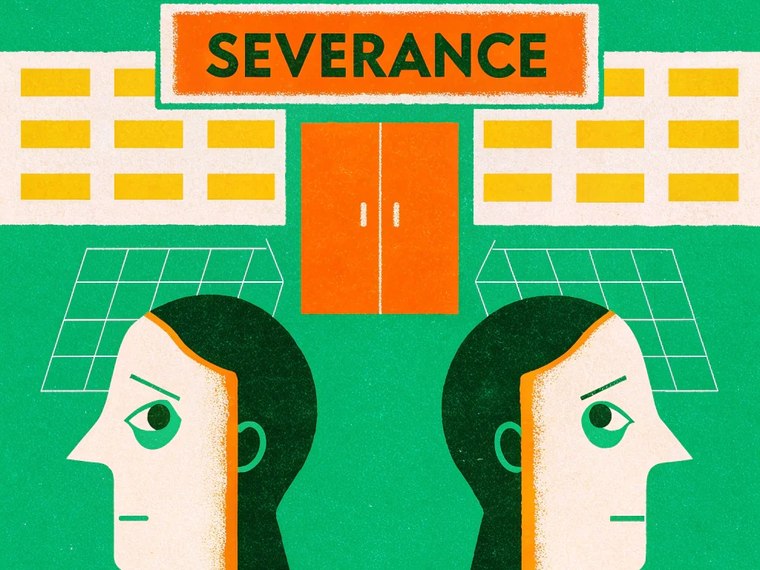
Series
Severance: Speak Like Your Innie

Lumon's corporate cult-speak against real workplace English.
Memes
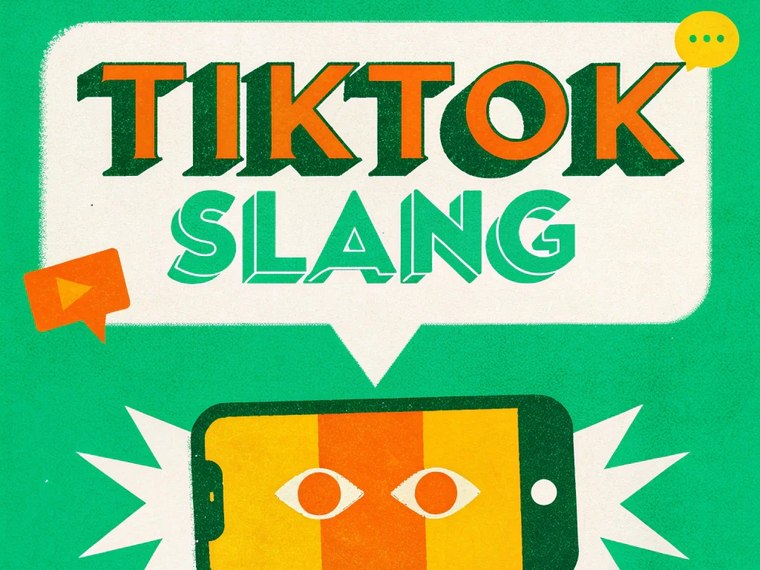
Caught in the Algorithm: TikTok Slang

38 Gen Z words that already reached work chats and the Oxford dictionary.

Sport
Formula 1: Speak Like a Champion

Team radio, strategy and business English at three hundred kilometres an hour.

New modules land as the seasons go: series, games, sport, music, trends.

Three months in

What it looks like when it works.

Depends on why you need English.

Work in an international team
A call where you push back instead of nodding.
Your own business or startup
An investor asks a question — and you answer instead of reading the slide.
Moving to another country
You negotiate with the landlord instead of agreeing to everything.
Friends and social life
At the table you tell your story, not just listen to others.

Say it out loud.

You already have everything you need. What is left is saying it — and the first time can be today.

Get it for iPhone

Your first conversation is five minutes after install. Alone in a room, nobody hears it.

Now you will say them
Let's park that for now. ·That's a fair point. ·Can we circle back? ·I'm not sold on it. ·Let me rephrase that. ·No pressure either way. ·That's on me. ·Give or take a day. ·Worth a shot. ·It slipped my mind. ·I'd rather hold off. ·Fair enough. ·That tracks. ·Let's tackle the big one first. ·Let's park that for now. ·That's a fair point. ·Can we circle back? ·I'm not sold on it. ·Let me rephrase that. ·No pressure either way. ·That's on me. ·Give or take a day. ·Worth a shot. ·It slipped my mind. ·I'd rather hold off. ·Fair enough. ·That tracks. ·Let's tackle the big one first. ·

iPhone only for now

There's no Android app yet. Leave your email — one message, when there is one.

Same idea: the words you understand but never say start coming out. Just a bit later.

One email, and only about that. Nothing else.

By leaving your email you agree to it being processed. Details are in the privacy policy.

Common questions